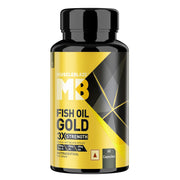
Fish oil has one of the strongest safety profiles of any common supplement, which leads a lot of people to assume more must be better. It isn't. Fish oil is still a concentrated source of fatty acids, and pushing well past effective dosage ranges can create real side effects without adding any extra benefit. Getting the dose right matters as much as choosing a good product in the first place.
The right dose depends heavily on why you're taking it — general health maintenance calls for a much smaller amount than someone training six days a week and specifically trying to manage inflammation and recovery.
Typical Effective Dosage Ranges for General Health
For general health maintenance, most guidance settles around 250-500mg combined EPA+DHA per day — roughly what you'd get from two to three servings of oily fish per week. This range is associated with baseline cardiovascular and general wellness support for people without specific elevated needs.
For more targeted goals — joint comfort, mood support, or higher inflammatory load from intense training — doses in the 1-3g combined EPA+DHA range per day are more commonly used. It's worth repeating: this is EPA+DHA combined, not total fish oil weight, which is often 2-3x higher than the actual active omega-3 content.
How Training Volume Might Influence Dosing Needs
People training at high volume or frequency generate more transient inflammation and joint stress than sedentary individuals, and this is one reason athletes and heavy lifters often sit at the higher end of the dosage range (2-3g/day) rather than the minimal maintenance dose.
- Lower training volume (2-3 sessions/week): 500mg-1g combined EPA+DHA is typically sufficient.
- Moderate training volume (4-5 sessions/week): 1-2g combined EPA+DHA is a reasonable middle ground.
- High training volume or in a heavy competition/cutting phase: 2-3g combined EPA+DHA is where most higher-end recommendations land, though going meaningfully beyond this offers diminishing returns.
There isn't a hard ceiling where fish oil suddenly becomes dangerous, but doses above roughly 3-5g combined EPA+DHA per day start to meaningfully increase the odds of side effects without proportional extra benefit for most people.
Signs of Taking Too Much Fish Oil
Excessive fish oil intake tends to announce itself through a fairly predictable set of symptoms rather than anything silent or dangerous:
- Digestive upset — loose stools, oily burps, or general GI discomfort are the most common early signs of overdoing it.
- Fishy aftertaste or reflux — worse with higher doses, especially on an empty stomach.
- Easy bruising or unusually light bleeding from minor cuts — fish oil has mild blood-thinning properties at higher doses, which is why anyone on blood thinners or preparing for surgery should get medical clearance before high-dose supplementation.
- Lowered blood pressure symptoms — lightheadedness in people who already run low blood pressure, since fish oil has a mild blood-pressure-lowering effect at higher intakes.
Practical tip: If you notice oily burps or loose stools after starting a new fish oil dose, that's your body's clearest signal to drop back to the previous dose level for a week or two rather than pushing through it.
How to Split Doses to Improve Tolerance
Most tolerance issues come down to taking too much fish oil in one sitting rather than the total daily amount itself. A few practical adjustments make a real difference:
Split into two servings
Taking half your daily dose with breakfast and half with dinner, rather than the full amount at once, meaningfully reduces GI discomfort for most people.
Always take with food
Fish oil is fat-soluble, so taking it with a meal that contains some fat improves absorption and significantly reduces reflux and burping compared to taking it on an empty stomach.
Try freezing the capsules
Some people find that freezing softgels delays their breakdown until further along in digestion, cutting down on the fishy aftertaste and burping.
Consider a triglyceride-form product
Fish oil in triglyceride form is generally better absorbed and better tolerated than the cheaper ethyl ester form, which can make a noticeable difference for people who've had GI issues with fish oil before.
- General health maintenance: 250-500mg combined EPA+DHA/day; targeted goals: 1-3g/day.
- Higher training volumes generally justify doses toward the higher end of that range, not beyond it.
- Doses above roughly 3-5g/day combined EPA+DHA increase side-effect risk without proportional added benefit.
- Digestive upset, fishy burps, and easy bruising are the clearest signs of taking too much.
- Splitting doses across two meals and choosing a triglyceride-form product both meaningfully improve tolerance.
Can I take fish oil on an empty stomach?
You can, but it significantly increases the odds of reflux, fishy aftertaste, and GI discomfort. Taking it with a meal containing some fat improves both absorption and tolerance.
Is it safe to combine fish oil with blood thinning medication?
Fish oil has mild blood-thinning properties on its own, so combining it with prescribed blood thinners should only be done with a doctor's guidance, particularly at doses above 1g/day.
Do I need to cycle off fish oil periodically?
Unlike some supplements, fish oil doesn't require cycling for most people — it's generally taken continuously as part of a daily routine, provided the dose stays within a reasonable range and tolerance remains good.