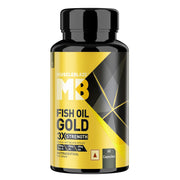
Walk down any supplement aisle and you'll see fish oil bottles proudly listing their EPA and DHA content, often in different ratios from brand to brand. Most people assume these two letters are interchangeable stand-ins for "omega-3," but EPA (eicosapentaenoic acid) and DHA (docosahexaenoic acid) are structurally distinct fatty acids that behave differently in the body. Understanding that difference changes how you should actually read a label and choose a product.
Both are long-chain omega-3 fatty acids found primarily in fatty fish and fish oil supplements (as opposed to ALA, the shorter-chain omega-3 found in flaxseed and walnuts, which the body converts to EPA and DHA only in small amounts). But once EPA and DHA are in your system, they get used for noticeably different purposes.
What EPA Is Primarily Associated With
EPA is most closely tied to the body's inflammatory response and cardiovascular signaling. It's a precursor to a class of signaling molecules called eicosanoids, which influence how the body manages inflammation, blood clotting, and blood vessel dilation. This is why EPA-heavy formulations are often marketed toward joint comfort, recovery from training, and general cardiovascular support.
People who are managing exercise-induced inflammation, or who simply want a fatty acid profile geared toward whole-body inflammatory balance, tend to look for products where EPA is the dominant fatty acid, sometimes in ratios of 2:1 or even 3:1 relative to DHA.
What DHA Is Primarily Associated With
DHA plays a more structural role. It's a major building block of cell membranes throughout the body, and it's especially concentrated in the brain and retina, where it makes up a substantial share of the fatty acid content of neural tissue. Because of this, DHA gets most of the attention in research and marketing related to cognitive function, mood, and eye health.
DHA is also the fatty acid prioritized during pregnancy and early development, since it's a key component of fetal brain and eye tissue. This is part of why many prenatal formulations lean DHA-dominant rather than EPA-dominant.
How to Read a Label for the EPA-to-DHA Ratio
Fish oil labels can be misleading if you only look at the "1000mg fish oil" headline number, since that often refers to total oil weight rather than the actual concentration of active omega-3s. To read a label properly:
- Look past the total fish oil weight and find the actual EPA and DHA milligrams listed separately.
- Add EPA + DHA together to get your true "active omega-3" dose per serving — this is often far lower than the headline number on cheaper products.
- Note the ratio: a product listing 600mg EPA / 300mg DHA per serving is roughly a 2:1 EPA-dominant formula, while 250mg EPA / 500mg DHA leans DHA-dominant.
- Check serving size — some labels quote per-capsule amounts while others quote per 2 or 3 capsules, which can make cross-brand comparisons misleading unless you standardize to a single serving.
Label tip: Ignore the total fish oil milligram count on the front of the bottle entirely. Flip to the supplement facts panel and add up EPA + DHA directly — that combined number, not the oil weight, is what determines whether you're getting a meaningful dose.
Choosing a Ratio Based on Your Goals
Neither fatty acid is "better" in isolation — the right ratio depends on what you're prioritizing:
If your focus is training recovery and joint comfort
An EPA-dominant formula (roughly 2:1 or higher EPA to DHA) aligns with the inflammatory-modulation research base and is a common choice among people doing high training volumes.
If your focus is cognitive function or general wellness
A balanced or DHA-leaning formula supports the structural role DHA plays in neural tissue, and is often the default choice for general health maintenance.
If you're unsure
A balanced 1:1 formula, or a whole-fish-oil product that simply reflects the natural ratio found in oily fish (roughly 1.2–1.5:1 EPA to DHA), is a reasonable default that avoids overcommitting to either function.
Whichever you choose, total daily EPA+DHA intake matters more than obsessing over the exact ratio for most people — aim for a meaningful combined dose (commonly 1-3g/day depending on goals) before worrying about fine-tuning the split between the two.
- EPA and DHA are both long-chain omega-3s but serve different primary functions in the body.
- EPA is more associated with inflammatory response and cardiovascular signaling.
- DHA is more associated with brain, cognitive, and eye structural health.
- Always check the actual EPA+DHA milligram content on the supplement facts panel, not the total fish oil weight on the front label.
- Choose an EPA-dominant ratio for recovery-focused goals, a DHA-dominant or balanced ratio for general and cognitive wellness.
Is a higher EPA-to-DHA ratio always better for athletes?
Not necessarily always, but EPA-dominant formulas are commonly preferred by people with high training volumes because of EPA's stronger association with inflammatory balance. That said, total combined EPA+DHA intake still matters more than the exact ratio for most people.
Can I get enough EPA and DHA from ALA-rich foods like flaxseed alone?
The body converts ALA to EPA and DHA very inefficiently, typically in the low single-digit percentages. Direct sources like fatty fish or fish oil supplements are a far more reliable way to reach meaningful EPA and DHA levels.
Does cooking fish reduce its EPA and DHA content?
Some loss occurs with high-heat cooking methods, though moderate cooking (baking, steaming) retains most of the omega-3 content. This is one reason supplements offer a more consistent, measurable dose compared to variable cooking losses in whole fish.